1GR-FE 4.0L
TID $07: A/F SENSOR HEATER
| TLT |
CID |
Unit Conversion |
Description of Test Data |
Description of Test Limit |
| 1 |
$01 |
Multiply by 0 00017 (A) |
Maximum heater current (Bank 1) |
Malfunction criterion for A/F sensor heater |
| 1 |
$10 |
Multiply by 0 00017 (A) |
Maximum heater current (Bank 2) |
Malfunction criterion for A/F sensor heater |
TID $04: HO2S HEATER
| TLT |
CID |
Unit Conversion |
Description of Test Data |
Description of Test Limit |
| 1 |
$02 |
Multiply by 0.000076 (A) |
Maximum HO2S heater current (Bank 1 sensor 2) |
Malfunction threshold for HO2S heater |
| 1 |
$04 |
Multiply by 0.000076 (A) |
Maximum HO2S heater current (Bank 1 Sensor 3) |
Malfunction threshold for HO2S heater |
| 1 |
$20 |
Multiply by 0.000076 (A) |
Maximum HO2S heater current (Bank 2 Sensor 2) |
Malfunction threshold for HO2S heater |
| 1 |
$40 |
Multiply by 0.000076 (A) |
Maximum HO2S heater current (Bank 2 Sensor 3) |
Malfunction threshold for HO2S heater |
TID $08: THERMOSTAT
| TLT |
CID |
Unit Conversion |
Description of Test Data |
Description of Test Limit |
| 1 |
$01 |
Multiply by 0.625 and subtract 40 (°C) |
ECT sensor output when estimated ECT has reached to malfunction criterion |
Malfunction criteria for thermostat |
HEATED OXYGEN SENSOR OUTPUT VOLTAGE
| Test ID/Comp ID |
Description of Test Date |
Conversion Factor |
Unit |
| $07 |
The minimum sensor voltage while the malfunction is being monitored |
N/A |
V |
| $08 |
The maximum sensor voltage while the malfunction is being monitored |
N/A |
V |
HEATED OXYGEN SENSOR
| Test ID/Comp ID |
Description of Test Data |
Conversion Factor |
Unit |
| $81 |
Percentage of monitoring time where heated oxygen sensor voltage is less than 0.05 V |
Multiply 0.3906 |
% |
| $84 |
Percentage of monitoring time where heated oxygen sensor voltage is 0.70 V or more |
Multiply 0.3906 |
% |
| $85 |
Maximum Rich (0.45 V or more) time |
Multiply 0.2621 |
second |
MISFIRE MONITOR - ALL CYLINDERS
| MID |
TID |
Scaling |
Description of Test Value |
Minimum Test Limit |
Maximum Test Limit |
| $A1 |
$OB |
Multiply by 1 [time] |
Exponential Weighted Moving Average misfire counts for last 10 driving cycles - total |
0 |
65535 |
| $A1 |
$OC |
Multiply by 1 [time] |
Misfire counts for last and current driving cycles - total |
0 |
65535 |
MISFIRE MONITOR - CYLINDER 1
| MID |
TID |
Scaling |
Description of Test Value |
Minimum Test Limit |
Maximum Test Limit |
| $A2 |
$OB |
Multiply by 1 [time] |
Exponential Weighted Moving Average misfire counts for last 10 driving cycles - total |
0 |
65535 |
| $A2 |
$OC |
Multiply by 1 [time] |
Misfire counts for last and current driving cycles - total |
0 |
65535 |
MISFIRE MONITOR - CYLINDER 2
| MID |
TID |
Scaling |
Description of Test Value |
Minimum Test Limit |
Maximum Test Limit |
| $A3 |
$OB |
Multiply by 1 [time] |
Exponential Weighted Moving Average Misfire counts for last 10 driving cycles- total |
0 |
65535 |
| $A3 |
$OC |
Multiply by 1 [time] |
Misfire counts for last and current driving cycles - total |
0 |
65535 |
MISFIRE MONITOR - CYLINDER 3
| MID |
TID |
Scaling |
Description of Test Value |
Minimum Test Limit |
Maximum Test Limit |
| $A4 |
$OB |
Multiply by 1 [time] |
Exponential Weighted Moving Average Misfire counts for last 10 driving cycles - total |
0 |
65535 |
| $A4 |
$OC |
Multiply by 1 [time] |
Misfire counts for last and current driving cycles - total |
0 |
65535 |
MISFIRE MONITOR - CYLINDER 4
| MID |
TID |
Scaling |
Description of Test Value |
Minimum Test Limit |
Maximum Test Limit |
| $A5 |
$OB |
Multiply by 1 [time] |
Exponential Weighted Moving Average Misfire counts for last 10 driving cycles - total |
0 |
65535 |
| $A5 |
$OC |
Multiply by 1 [time] |
Misfire counts for last and current driving cycles - total |
0 |
65535 |
MISFIRE MONITOR - CYLINDER 5
| MID |
TID |
Scaling |
Description of Test Value |
Minimum Test Limit |
Maximum Test Limit |
| $A6 |
$OB |
Multiply by 1 [time] |
Exponential Weighted Moving Average misfire counts for last 10 driving cycles - total |
0 |
65535 |
| $A6 |
$OC |
Multiply by 1 [time] |
Misfire counts for last and current driving cycles - total |
0 |
65535 |
MISFIRE MONITOR - CYLINDER 6
| MID |
TID |
Scaling |
Description of Test Value |
Minimum Test Limit |
Maximum Test Limit |
| $A7 |
$OB |
Multiply by 1 [time] |
Exponential Weighted Moving Average misfire counts for last 10 driving cycles - total |
0 |
65535 |
| $A7 |
$OC |
Multiply by 1 [time] |
Misfire counts for last and current driving cycles - total |
0 |
65535 |
TID $01: CATALYST (ACTIVE A/F CONTROL METHOD)
| TLT |
CID |
Unit Conversion |
Description of Test Data |
Description of Test Limit |
| 1 |
$01 |
Multiply by 0.0078 (no dimension) |
Oxygen storage capacity (bank 1): |
|
| |
|
|
Calculated by HO2S sensor 2 output |
Malfunction criteria for catalyst deterioration |
| 1 |
$02 |
Multiply by 0.0078 (no dimension) |
Oxygen storage capacity (bank 2): |
|
| |
|
|
Calculated by HO2S sensor 2 output |
Malfunction criteria for catalyst deterioration |
TID $06: A/F SENSOR (ACTIVE A/F CONTROL METHOD)
| TLT |
CID |
Unit Conversion |
Description of Test Data |
Description of Test Limit |
| 1 |
$01 |
Multiply by 0.0003 (V) |
Cumulative A/F sensor locus length (Bank 1) |
Lower malfunction criterion for A/F sensor |
| 0 |
$01 |
Multiply by 0.0003 (V) |
Cumulative A/F sensor locus length (Bank 1) |
Upper malfunction criterion for A/F sensor |
| 1 |
$11 |
Multiply by 0.0003 (V) |
Cumulative A/F sensor locus length (Bank 2) |
Lower malfunction criterion for A/F sensor |
| 0 |
$11 |
Multiply by 0.0003 (V) |
Cumulative A/F sensor locus length (Bank 2) |
Upper malfunction criterion for A/F sensor |
| 1 |
$02 |
Multiply by 0.000039 (A) |
A/F sensor current (Bank 1) |
Lower malfunction criterion for A/F sensor |
| 0 |
$02 |
Multiply by 0.000039 (A) |
A/F sensor current (Bank 1) |
Upper malfunction criterion for A/F sensor |
| 1 |
$12 |
Multiply by 0.000039 (A) |
A/F sensor current (Bank 2) |
Lower malfunction criterion for A/F sensor |
| 0 |
$12 |
Multiply by 0.000039 (A) |
A/F sensor current (Bank 2) |
Upper malfunction criterion for A/F sensor |
EVAP
| MID |
TID |
Scaling |
Description of Test Value |
Minimum Test Limit |
Maximum Test Limit |
| $3D |
$C9 |
Multiply by 0.01 [kPa] |
Test value for small leak (P0456). Refer to pressure D |
Minimum test limit for small leak |
Maximum test limit for small leak |
| $3D |
$CA |
Multiply by 0.01 [kPa] |
Test value for gross leak (P0455). Refer to pressure E |
Minimum test limit for gross leak |
Maximum test limit for gross leak |
| $3D |
$CB |
Multiply by 0.01 [kPa] |
Test value for vacuum pump stuck OFF (P2401). Refer to pressure A |
Minimum test limit for vacuum pump stuck OFF |
Maximum test limit for vacuum pump stuck OFF |
| $3D |
$CD |
Multiply by 0.01 [kPa] |
Test value for vacuum pump stuck ON (P2402). Refer to pressure A |
Minimum test limit for vacuum pump stuck ON |
Maximum test limit for vacuum pump stuck ON |
| $3D |
$CE |
Multiply by 0.01 [kPa] |
Test value for vent valve stuck OFF (vent) (P2420). Refer to pressure C |
Minimum test limit for vent valve stuck ON |
Maximum test limit for vent valve stuck ON |
| $3D |
$CF |
Multiply by 0.01 [kPa] |
Test value for vent valve stuck ON (P2419). Refer to pressure A |
Minimum test limit for vent valve stuck OFF |
Maximum test limit for vent valve stuck OFF |
| $3D |
$D0 |
Multiply by 0.01 [kPa] |
Test value for 0.02 inch orifice low flow (P043E). Refer to pressure B |
Minimum test limit for 0.02 inch low flow |
Maximum test limit for 0.02 inch low flow |
| $3D |
$D1 |
Multiply by 0.01 [kPa] |
Test value for 0.02 inch orifice high flow (P043F). Refer to pressure A |
Minimum test limit for 0.02 inch high flow |
Maximum test limit for 0.02 inch high flow |
| $3D |
$D4 |
Multiply by 0.01 [kPa] |
Test value for purge VSV stuck close (P0441). Refer to pressure F |
Minimum test limit for purge VSV stuck close |
Maximum test limit for purge VSV stuck close |
| $3D |
$D5 |
Multiply by 0.01 [kPa] |
Test value for purge VSV stuck open (P0441). Refer to pressure E |
Minimum test limit for purge VSV stuck open |
Maximum test limit for purge VSV stuck open |
| $3D |
$D7 |
Multiply by 0.01 [kPa] |
Test value for purge flow (P0441). Refer to pressure G |
Minimum test limit for purge flow |
Maximum test limit for purge flow |
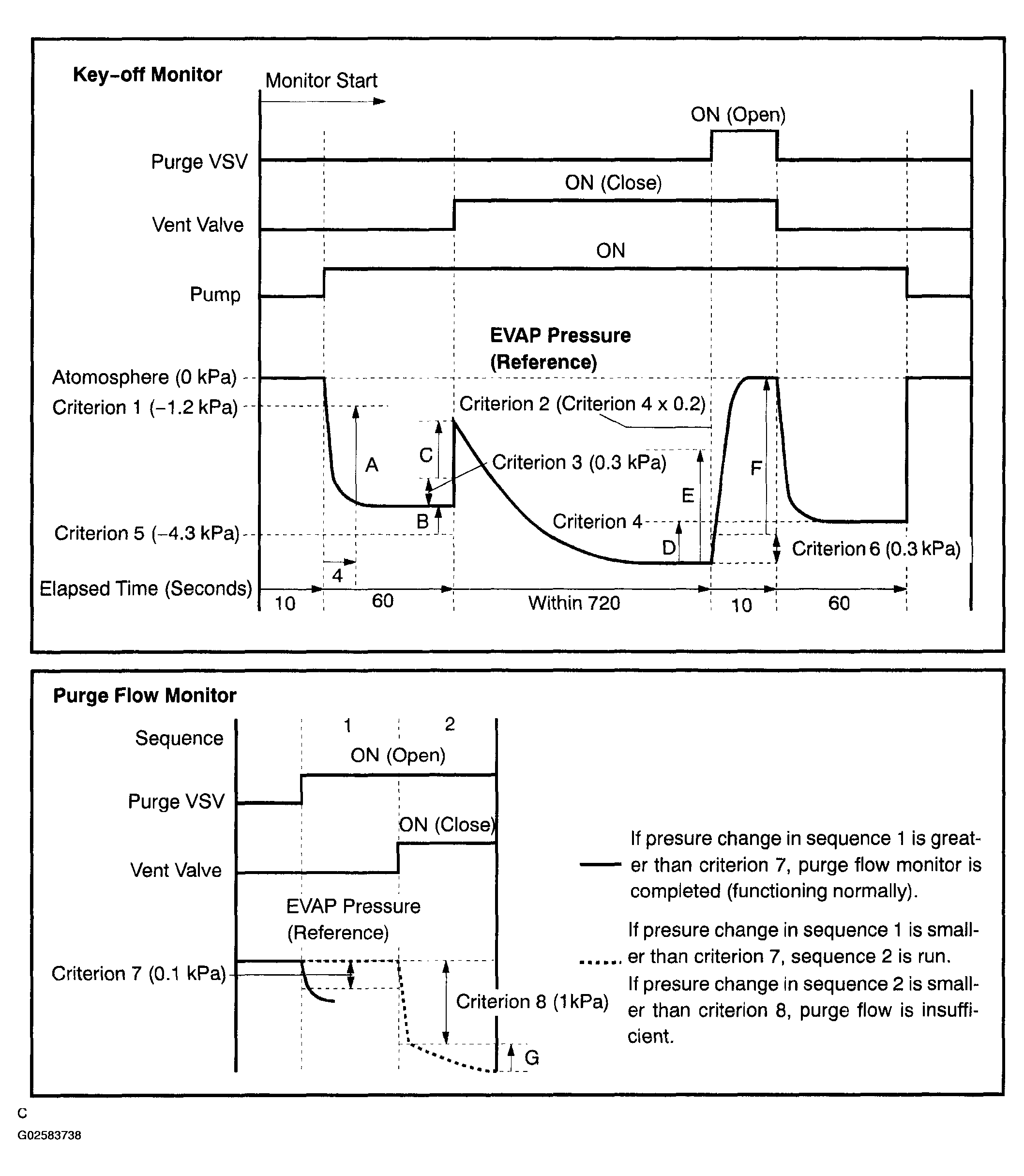 Courtesy of © TOYOTA, LICENSE AGREEMENT TMS1002