DTC P0452: EVAP System Pressure Sensor Low Input - Legacy
- Turn ignition off. Remove and reinstall fuel filler cap. Connect scan tool. Turn ignition on. Observe fuel tank pressure sensor signal. If value is less than -0.827 in. Hg, go to next step. If value is -0.827 in. Hg or more, system has returned to normal. Check for intermittent open or short in wiring between fuel tank pressure sensor connector and ECM. See appropriate wiring diagram in WIRING DIAGRAMS
article. If wiring is okay, check for poor contact at ECM, or fuel tank pressure sensor connectors.
- Using a voltmeter connected to ground, backprobe ECM connector B136 (30-pin connector) terminal No. 15. See Figure. If voltage is 4.5 volts or more, go to next step. If voltage is less than 4.5 volts, wiggle harness and ECM connector while backprobing. If voltage changes to 4.5 volts or more, check for an open in wiring between ECM and fuel tank pressure sensor connectors, or for poor contact at ECM. If voltage does not change, replace ECM.
- Using a voltmeter connected to ground, backprobe ECM connector B136 (30-pin connector) terminal No. 12. If voltage is less than .2 volt, go to next step. If voltage is .2 volt or more, observe fuel tank pressure sensor signal on scan tool while wiggling harness and ECM connector. Check if value changes more than -0.827 in. Hg when wiggling ECM connector. If value changes, check for an open in wiring or for poor contact at ECM connector. If value does not change, go to next step.
- Turn ignition off. Disconnect 6-pin in-line connector located between rear wiring harness and fuel tank harness (under rear seat), nearest fuel tank. Turn ignition on. Check voltage between ground and ECM-side of 6-pin in-line connector terminal No. 5. See Figure. If voltage is less than 4.5 volts, check for an open in wiring between ECM and in-line connectors. If voltage is 4.5 volts or more, go to next step.
- Turn ignition off. Disconnect ECM connector B136 (30-pin connector). Using an ohmmeter, measure resistance between ECM connector B136 (30-pin connector) terminal No. 16 and ECM-side of 6-pin in-line connector terminal No. 3. If resistance is less than one ohm, go to next step. If resistance is one ohm or more, check for an open in wiring between ECM and in-line connectors.
- Measure resistance between ground and ECM-side of 6-pin in-line connector terminal No. 3. If resistance is more than 500 k/ohms, go to next step. If resistance is 500 k/ohms or less, check for short in wiring between ECM and in-line connectors.
- Disconnect fuel tank pressure sensor connector. Measure resistance between fuel tank pressure sensor harness connector terminal No. 3 and fuel-tank side of 6-pin in-line connector terminal No. 5. See Figure and Fig 1
. If resistance is less than one ohm, go to next step. If resistance is one ohm or more, repair open in fuel tank harness.
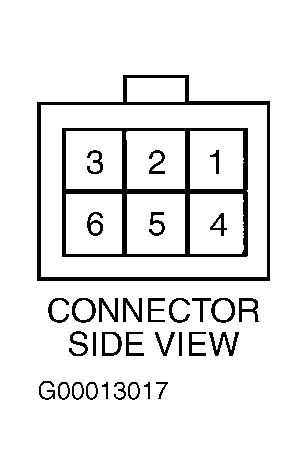 Courtesy of SUBARU OF AMERICA, INC.
- Measure resistance between fuel tank pressure sensor harness connector terminal No. 1 and fuel-tank side of 6-pin in-line connector terminal No. 3. If resistance is less than one ohm, go to next step. If resistance is one ohm or more, repair open in fuel tank harness.
- Measure resistance between ground and fuel tank pressure sensor harness connector terminal No. 2. If resistance is more than 500 k/ohms, go to next step. If resistance is 500 k/ohms or less, repair short in fuel tank harness.
- Check for poor terminal contact at fuel tank pressure sensor connector. If terminal contact is okay, replace fuel tank pressure sensor.