Idling And Power Transition
- At idle speed, with engine at normal operating temperature, fuel is drawn up from carburetor bowl through the main jet, metered through idle jet, and across to the idle passage, where it is mixed with air entering through the calibrated air bleed and then through upper idle mixture port. Air/fuel mixture enters throttle bore below throttle plate through lower idle mixture port. Amount of mixture is regulated by adjustment of idle mixture adjustment screw. At this point, mixture is further mixed with air drawn past the slightly opened throttle plate, regulated by adjustment of idle speed adjustment screw.
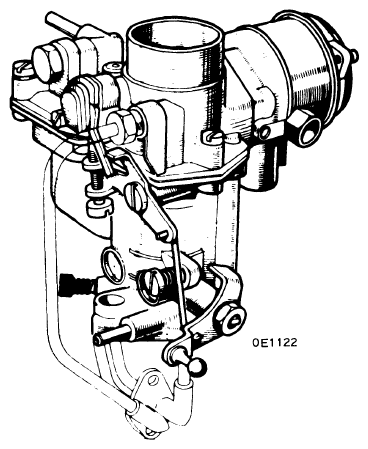 Courtesy of AMERICAN MOTORS/RENAULT CORP.
- As throttle, controlled through linkage by accelerator pedal, begins to open, the amount of air flow past throttle plate is gradually increased. As air flow increases, it begins to draw air/fuel mixture through upper idle mixture port, in addition to mixture already being drawn through lower idle mixture port, providing a proportionate increase in air/fuel mixture.
- As throttle is opened still further, the point of highest vacuum moves to main venturi and booster venturi. Fuel then flows through main jet into discharge tube. Vaporization of fuel is accomplished first through the calibrated air bleed, second at the outlet end of discharge tube, and finally at booster venturi and main venturi. Amount of air/fuel mixture entering manifold is controlled by amount that throttle plate is opened.