Automatic Choke
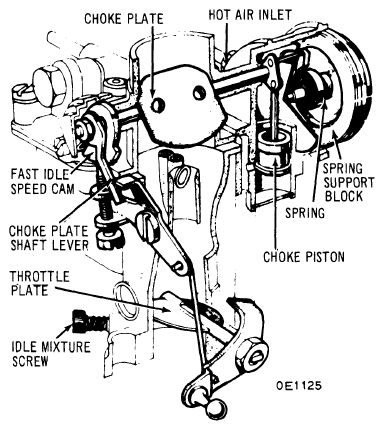
- When engine has been stopped long enough to become cold, choke plate tends to close, because of tension of thermostatic spring. This spring is made so that it winds up when it is hot, and releases itself when it is cold. Center of spring is fixed so that a winding action is effective at outer end, which is in contact with a pin connected to choke plate shaft. Plate cannot close, however, as cam resting on stop screw holds it open. To release choke, it is necessary to depress accelerator pedal once, and then release it, in order to clear fast idle cam and allow choke plate to close.
- When choke plate is closed, throttle plate is held partially open as fast idle adjustment screw rests on highest step of cam. Volume of air and air/fuel mixture will therefore be greater than at normal idle speed, and engine will operate at a fast idle speed.
 Courtesy of AMERICAN MOTORS/RENAULT CORP.
- A cold air inlet tube conducts filtered air to curved U-shaped pipe installed in exhaust manifold. A hot air inlet tube, which passes behind carburetor, conducts heated air through the union. This air heats thermostatic spring and support block. Purpose of this block is to absorb a large quantity of heat and to store this heat. Without this block, spring would heat and wind too rapidly. Also, when engine is stopped, spring would cool down and would release too rapidly. The block communicates its heat to the spring and retards this action.
- As soon as engine starts, vacuum created in intake manifold exerts a downward pull on choke piston. The choke plate which was closed when starting, begins opening as piston pulls downward against action of thermostatic spring, and progressively opens as spring winds up when heated.