Hydraulic System Pressure Test
- Check power steering pump drive belt tension and adjust if necessary. Disconnect high pressure hose from power steering pump. Connect Pressure Gauge (6815) to both hoses. See Fig 1. Connect adapter hoses to steering gear and pump lines.
- Check fluid level and adjust if necessary. Completely open test valve. Start engine and let idle. At idle, gauge reading should be less than 125 psi (8.6 kg/cm2
). Initial pressure should be 50-80 psi (3.5-5.6 kg/cm2
).
CAUTION:
DO NOT
leave test valve closed for more than 5 SECONDS or operate pump with steering gear against stops for more than 2-4 SECONDS, as power steering pump may be damaged. Power steering pump maximum relief pressure is 1195-1293 psi (82.4-89.2 kg/cm2
).
- Fully close test valve 3 times, and record highest pressure reading each time. All 3 pressure readings must be within specification and within 50 psi (3.5 kg/cm2
) of each other.
- If pressure readings are as specified, go to next step. If pressure readings are greater than specification but not within 50 psi (3.5 kg/cm2
) of each other, replace power steering pump. If pressure readings are within 50 psi (3.5 kg/cm2
) of each other but less than specification, replace power steering pump.
- Completely open test valve. Turn steering wheel left then right against stops. Record highest pressure reading at each stop. If highest pressure reading at each stop is not the same, power steering pump is leaking internally. Replace power steering pump.
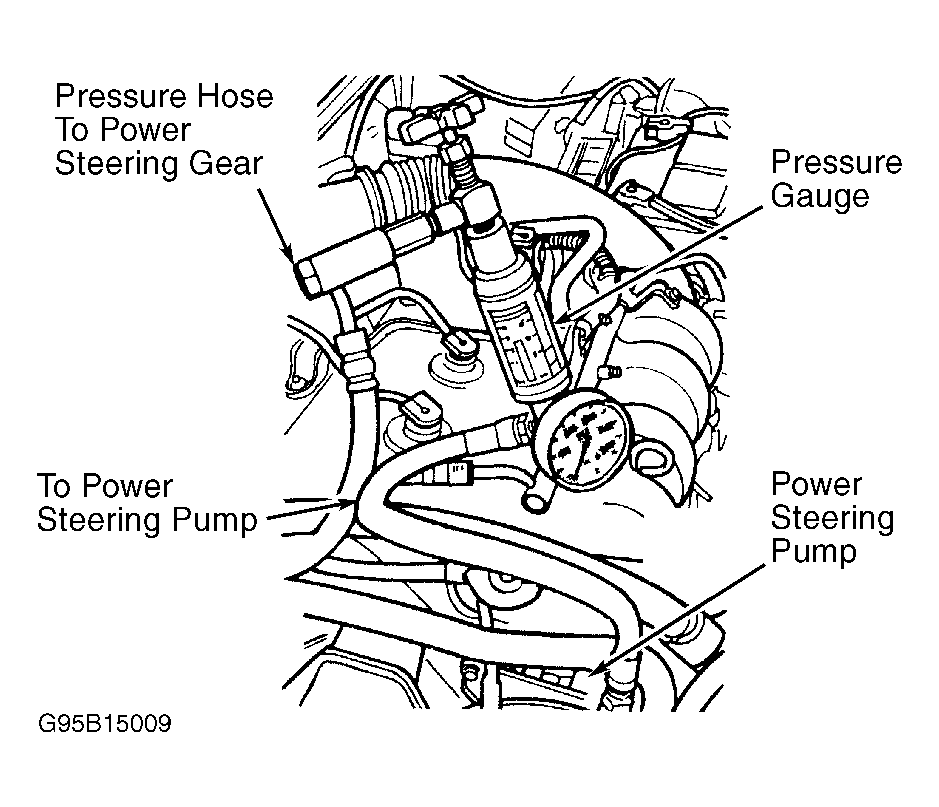 Courtesy of CHRYSLER CORP.
 POWER STEERING PUMP SPECIFICATIONS
| Application |
Specifications |
| Pressure Relief |
1195-1293 psi (82.4-89.2 kg/cm2
) |
| Minimum Pump Flow |
1.3-1.9 GPM (4.7-7.1 L/min.) |