"G" Sensor Output Signal
- Park vehicle on level surface. Using Multi-Use Tester, check "G" sensor voltage. Refer to Multi-Use Tester II (MUT-II) instructions for specific test procedure. Voltage should be 2.38-2.62 volts. If voltage is not as described, go to step 3). If voltage is as described, note top center position of "G" sensor, and remove "G" sensor, located under center console next to shifter. See "G" SENSOR
.
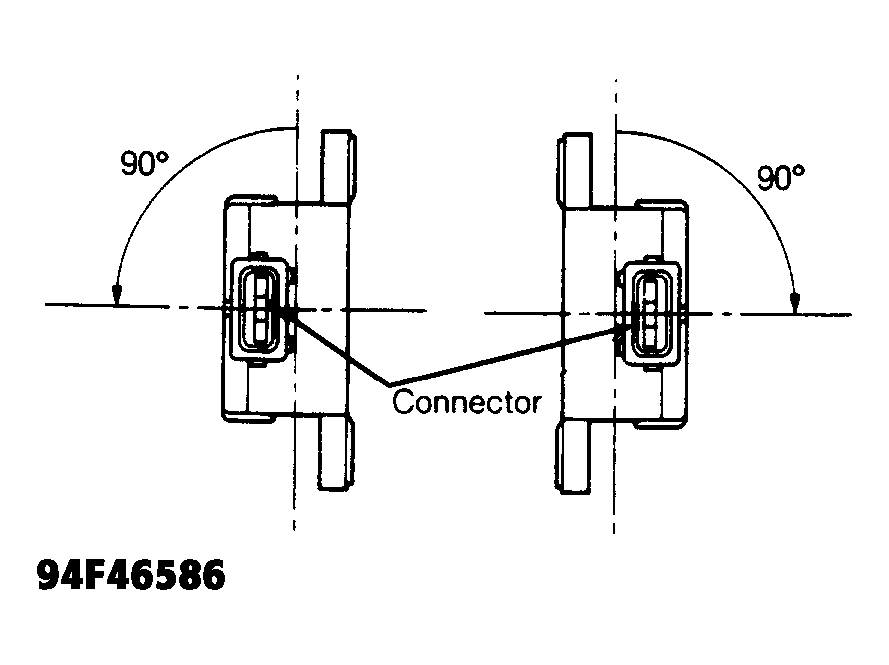
- Check voltage when sensor is tilted 90 degrees to the left of center. See Fig 1
. Voltage should be 1.3-3.6 volt. Tilt sensor 90 degrees to right of center and check voltage. Voltage should be 3.4-3.6 volts. If voltage is as described, substitute ECU with known good unit and retest. If voltage is not as described, replace "G" sensor.
 Courtesy of MITSUBISHI MOTOR SALES OF AMERICA
- If "G" sensor voltage is less than 0.5 volt, go to next step. If "G" sensor voltage is more than 4.5 volts, go to step 9). If "G" sensor voltage is 0.3-4.7 volts, check for poor vehicle ground connection (loose mounting bolt) at sensor. Repair as necessary. If connection is okay, replace "G" sensor.
- Start engine. Disconnect "G" sensor harness connector. Using DVOM, measure voltage between sensor harness connector terminal No. 1 (Blue wire) and ground. If battery voltage is not present, inspect and repair circuit between terminal No. 1 and fuse No. 7.
- If battery voltage is present, connect sensor harness connector. Backprobe sensor harness connector terminal No. 3 (Black/Red wire). Measure voltage between terminal No. 3 and ground. Ensure vehicle is on level surface.
- If voltage is 2.38-2.62 volts, go to step 8). If voltage is not 2.38-2.62, turn ignition to switch ACC position. Disconnect "G" sensor connector. Using ohmmeter, check resistance between terminal No. 3 (Blue/White) and vehicle ground. Resistance should be 500 ohms or more. If resistance is within specification, replace "G" sensor.
- If resistance is not 500 ohms or more, turn ignition off. Disconnect "G" sensor and ECU connectors. Check continuity between terminal No. 3 and vehicle ground. If continuity does not exist, substitute ECU with known good unit and retest. If continuity exists, repair wiring harness between ECU and "G" sensor.
- Turn ignition on. Using DVOM, check voltage at ECU terminal No. 110 and vehicle ground. See Figure
. Voltage should be 2.38-2.62 volts. If voltage is within specification, substitute ECU with known good unit and retest. If voltage is not 2.38-2.62 volts, repair wiring harness between ECU and "G" sensor.
- Disconnect "G" sensor connector. Using ohmmeter, check continuity between terminal No. 2 (Blue/White) and vehicle ground. If continuity exists, replace "G" sensor. If continuity does not exist, check continuity between ECU terminal No. 111 and vehicle ground. If continuity exists, repair wiring harness between ECU and "G" sensor. If continuity does not exist, substitute ECU with known good unit and retest.