Fuel Tank Inspection: 2WD
- Level the vehicle.
- Complete the "BEFORE SERVICE PRECAUTION". (See Before Service Precaution .)
- Drain the fuel. (See Fuel Draining Procedure .)
- Remove the rear seat cushion. (See REAR SEAT CUSHION REMOVAL/INSTALLATION
.)
- Remove the service hole cover.
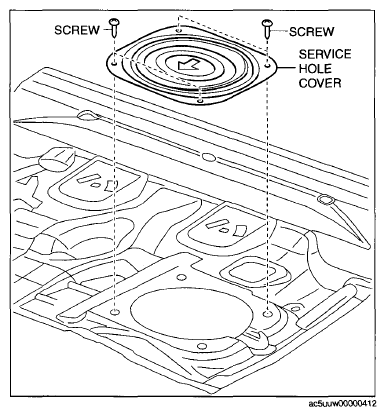 Courtesy of MAZDA MOTORS CORP.
- Disconnect the following parts:
- Remove the floor under cover. (See FLOOR UNDER COVER REMOVAL/INSTALLATION
.)
- Disconnect the HO2S connector.
- Remove the TWC and HO2S as a single unit. (See Exhaust System Removal/Installation
)
- Remove the propeller shaft. (See PROPELLER SHAFT REMOVAL/INSTALLATION
.)
- Remove the fuel tank, fuel pump unit and fuel gauge sender unit (sub) as a single unit. (See Fuel Tank Removal/Installation )
- Perform the following procedure to verify the fuel tank airtightness.
- Plug the fuel pump unit pipe, and ports B and C.
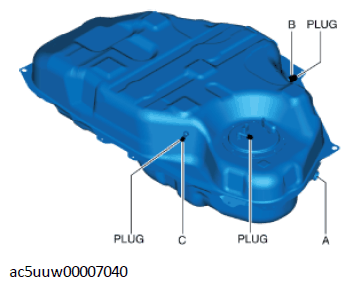 Courtesy of MAZDA MOTORS CORP.
- Apply pressure of 5.9 kPa {44 mmHg, 1.7 inHg} to port A and wait for a while.
- Verify that there is no change in the pressure and no air leakage from the fuel tank.
- Remove the port C plug.
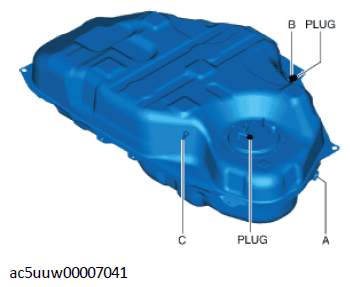 Courtesy of MAZDA MOTORS CORP.
- Place the fuel tank in a level position.
- Close port A and apply 5.9 kPa {44 mmHg, 1.7 inHg} of pressure to port C, and leave it in this condition momentarily.
- Open port A and verify that the pressure decreases from 5.9 kPa {44 mmHg, 1.7 inHg}.
- Close port A and apply -2.0 kPa {-15 mmHg, -0.59 inHg} vacuum to port C, and leave it in this condition momentarily.
- Open port A and verify that the -2.0 kPa {-15 mmHg, -0.59 inHg} negative pressure condition restores to near positive pressure.
- Turn the fuel tank upside down.
- Apply pressure of 5.9 kPa {44 mmHg, 1.7 inHg} to port A and wait for a while.
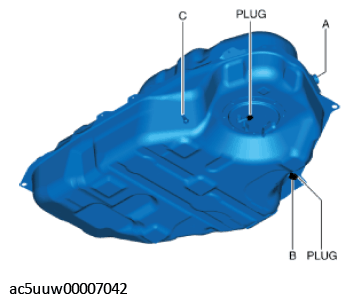 Courtesy of MAZDA MOTORS CORP.
- Verify that there is no change in the pressure and no air leakage from the port C.