Diagnosis & Repair Procedure
- Turn ignition off. Connect scan tool to DLC-2. Turn ignition on, engine off. Monitor for FREEZE FRAME DATA and ensure data has been recorded. Check service bulletins for repair information related to this DTC. If repair information is not available, go to next step. If repair information is available, perform diagnosis and repair as necessary. After repair, go to step 9.
- Turn ignition switch off, then start engine. Using scan tool, check for DTCs. See RETRIEVING DIAGNOSTIC TROUBLE CODES under SELF-DIAGNOSTIC SYSTEM. If any other DTCs, except P0131 and P0132, are present, repair those DTCs first. If no other DTCs, except P0131 and P0132, are present, go to next step.
- Check if DTC P0134 is present in FREEZE FRAME DATA. If DTC is present, go to next step. If DTC is not present, problem is intermittent. See INTERMITTENTS
in TROUBLE SHOOTING - NO CODES article.
- Start engine and warm up to normal operating temperature. Using scan tool, access O2S11 PID data. Depress accelerator pedal to Wide Open Throttle (WOT) and release to race engine. Scan tool should display O2S11 PID is more than .55 volt during acceleration (rich condition) and less than .55 volt during deceleration when fuel is cut (lean condition). If PID voltage is as specified, go to step 7. If PID voltage is not as specified, go to next step.
- Check front HO2S installation. If front HO2S is tight, go to next step. If front HO2S is loose, repair as necessary and go to step 9.
- Check for exhaust leak upstream of front HO2S. If exhaust leak is found, repair as necessary and go to step 9. If no problem is found, check for open or short in Pink/Blue wire between front HO2S harness connector terminal "A" and PCM 104-pin harness connector terminal No. 60. See Figure and Fig 1
. Repair as necessary and go to step 9. If wire is okay, replace front HO2S and go to step 9.
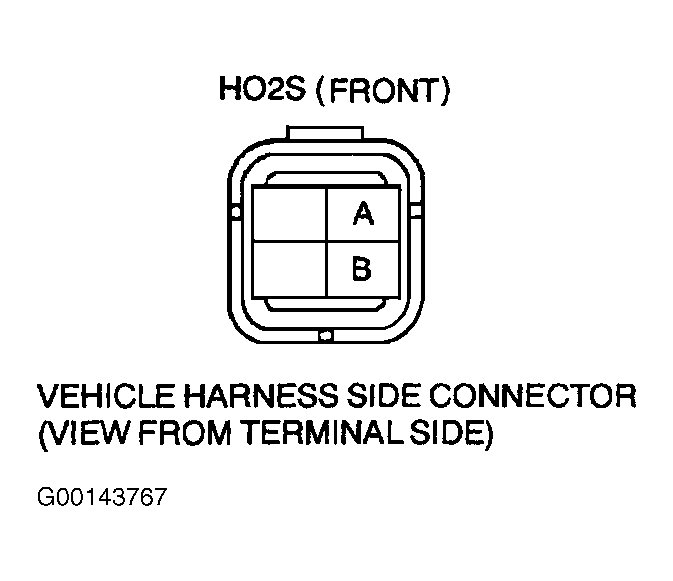 Courtesy of MAZDA MOTORS CORP.
- Check cooling system for combustion gases. If no problem is found, go to next step. If combustion gases are found in cooling system, repair leak and go to step 9.
- Check engine compression. See MECHANICAL INSPECTION
under PRELIMINARY INSPECTION & ADJUSTMENTS in BASIC DIAGNOSTIC PROCEDURES article. Engine compression should be a minimum of 119 psi (8.4 kg/cm2
) at 300 RPM with a maximum variation of 28 psi (2 kg/cm2
). If compression is as specified, go to next step. If compression is not as specified, repair engine as necessary and go to next step.
- Reconnect all connectors. Turn ignition switch on, engine off. Clear DTCs. See CLEARING DIAGNOSTIC TROUBLE CODES under SELF-DIAGNOSTIC SYSTEM. Start engine. Using scan tool, access ECT and RPM PIDs. Ensure ECT PID is more than 158°F (70°C). Increase and hold engine speed to more than 1500 RPM (RPM PID reading) for more than 120 seconds. Check for DTCs. See RETRIEVING DIAGNOSTIC TROUBLE CODES under SELF-DIAGNOSTIC SYSTEM. If DTC P0134 is present, replace PCM and go to next step. If DTC P0134 is not present, go to next step.
- Cycle ignition switch from off to on. Check for DTCs. See RETRIEVING DIAGNOSTIC TROUBLE CODES under SELF-DIAGNOSTIC SYSTEM. If no other DTCs are present, testing is complete. If any other DTC is present, go to applicable test and repair.