Diagnostic Procedure
- Turn ignition off. Connect New Generation Star (NGS) tester or equivalent to OBD-II Data Link Connector-2 (DLC-2). See Figure. Turn ignition on. Monitor for FREEZE FRAME DATA and ensure data has been recorded. Check for service bulletins and/or other line of repair information related to this DTC. If repair information is available, perform diagnosis and repair as necessary. After repair, go to step 10. If repair information is not available, go to next step.
- Leave ignition on. Using NGS tester or equivalent, clear DTCs from PCM memory. Start engine and let it idle until it reaches normal operation temperature. Monitor for DTCs. If DTC P1569 is present again, go to next step. If DTCs are not present, problem is intermittent. See INTERMITTENTS
in TROUBLE SHOOTING - NO CODES article.
- Turn ignition off. Disconnect VTCS solenoid valve vacuum hose that connects to intake manifold. Connect vacuum pump to VTCS solenoid valve. Turn ignition on. Apply vacuum and wait for 5 seconds. If VTCS solenoid valve holds vacuum, go to step 5. If VTCS solenoid valve does not holds vacuum, go to next step.
- Turn ignition off. Disconnect VTCS solenoid valve 2-pin harness connector. See Fig 1. Apply vacuum to VTCS solenoid valve. If VTCS solenoid valve holds vacuum, repair short circuit to ground (in Black/White wire) between VTCS solenoid valve and PCM. After repair, go to step 10. If VTCS solenoid valve does not hold vacuum, replace VTCS solenoid valve. After repair, go to step 10.
- Turn ignition off. Disconnect VTCS solenoid valve 2-pin harness connector. See Fig 1. Check for poor connection at VTCS solenoid valve connector terminals due to damaged, pulled-out pins, corrosion, etc. If connector terminals are okay, go to next step. If connector terminals are found faulty, repair or replace as necessary. For circuit identification, see MIATA
in WIRING DIAGRAMS article. After repair, go to step 10.
- With VTCS solenoid valve harness connector disconnected, measure resistance between VTCS solenoid valve connector terminals "A" and "B" (component side). Resistance should be more than 28 ohms. If resistance is as specified, go to next step. If resistance is not as specified, replace VTCS solenoid valve. After repair, go to step 10.
- With VTCS solenoid valve harness connector disconnected, turn ignition on. Measure voltage between ground and VTCS solenoid valve connector terminals "A". If battery voltage is found, go to next step. If battery voltage is not found, repair open or short circuit (in White/Red wire) between VTCS solenoid valve and PCM. After repair, go to step 10.
- Turn ignition off. Leave VTCS solenoid valve harness connector disconnected and disconnect PCM 17-pin harness connector. See Fig 1. Check for poor connection at PCM connector terminal "2N" due to damaged, pulled-out pins, corrosion, etc. If connector terminals are okay, go to next step. If connector terminals are found faulty, repair or replace as necessary. After repair, go to step 10.
- Reconnect VTCS solenoid valve harness connector and leave PCM harness connector disconnected. Turn ignition on. Measure voltage between ground and PCM harness connector terminal "2N" (Black/White wire). If battery voltage is found, go to next step. If battery voltage is not found, repair open or short circuit (in Black/White wire) between VTCS solenoid valve and PCM. After repair, go to next step.
- Return vehicle to original condition. Using NGS tester or equivalent, clear DTCs from PCM memory. Start engine and let it idle until it reaches normal operation temperature. Monitor for DTCs. If same DTC P1569 is present, replace PCM. For PCM removal and installation, see POWERTRAIN CONTROL MODULE
in REMOVAL, OVERHAUL & INSTALLATION article. If any other DTC is present, follow appropriate DTC diagnostic procedure.
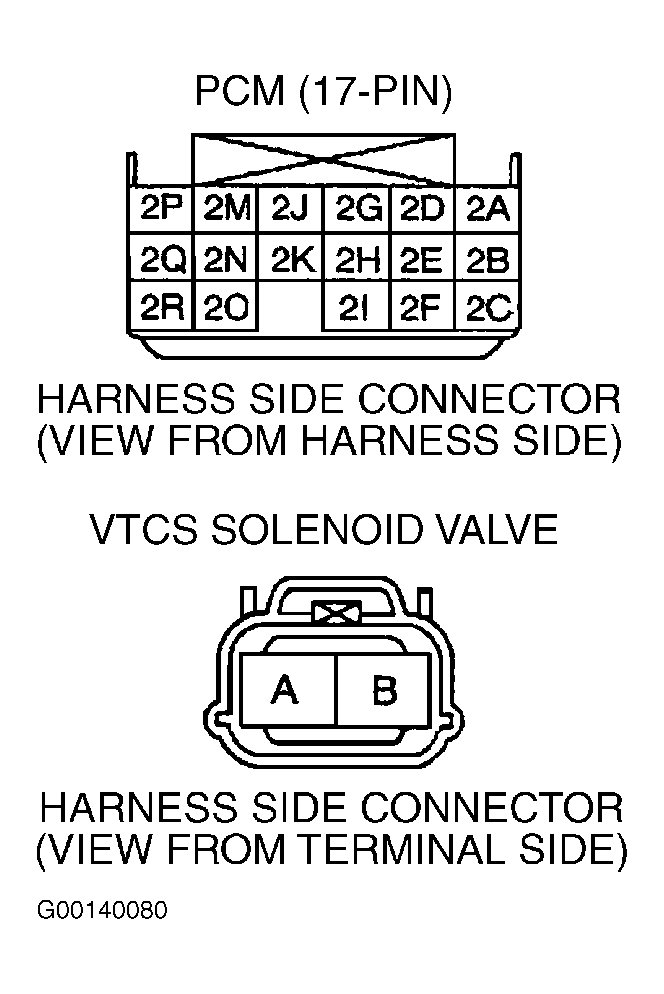 Courtesy of MAZDA MOTORS CORP.