- Raise front and rear of vehicle.
WARNING:
Do not work on or under a vehicle supported only by a jack. Always support the vehicle on safety stands.
- Check all pipe and hose connections are tight and there are no signs of leakage.
- Top-up fluid level in brake reservoir to 'MAX' mark.
CAUTION:
Never re-use fluid that has been bled from the system.
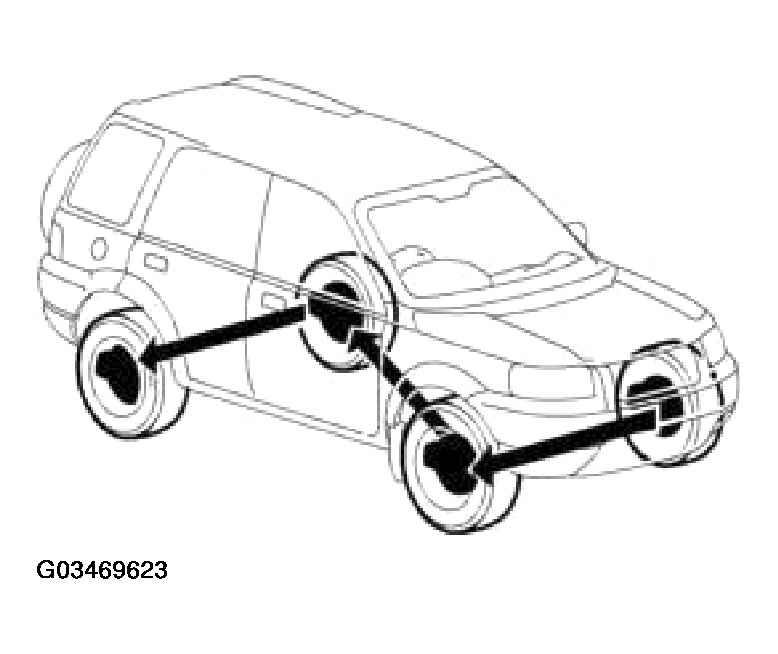 Courtesy of LAND ROVER NORTH AMERICA, INC.
- Bleed sequence: LH front to RH front, LH rear to RH rear.
CAUTION:
Use only new brake fluid of the recommended grade.
- Attach bleed tube to front brake caliper bleed screw on passenger side, submerge free end in a clear container containing brake fluid.
CAUTION:
Brake fluid will damage paint finished surfaces. If spilled, immediately remove fluid and clean area with water.
- Apply pressure to brake pedal several times, then apply steady pressure.
- Loosen bleed screw to release brake fluid and air. Allow pedal to return unassisted.
- Depress brake pedal steadily through its full stroke and allow to return unassisted. Repeat procedure until a flow of clean air-free fluid is purged into container then, while holding pedal at end of downward stroke tighten bleed screw to 10 Nm (7.5 lbf.ft) on calipers and 8 Nm (6 lbf.ft) on wheel cylinders.
CAUTION:
Ensure the fluid in the reservoir is maintained between the minimum and maximum levels throughout the bleed procedure using new brake fluid.
- Top up brake system reservoir.
- Repeat procedure at each wheel in the sequence shown.
WARNING:
Braking efficiency may be seriously impaired if the incorrect bleed sequence is used.
- Remove tube from bleed screw and fit bleed screw dust cap.
- Apply brakes and check for leakage.
- Remove stands and lower vehicle.
- Road test vehicle. Check brake pedal for short firm travel when brakes are applied.