Pinpoint Tests HX: Evaporative Emission (EVAP) Monitor And System: Introduction
WARNING:
TO PREVENT THE RISK OF HIGH-VOLTAGE SHOCK, ALWAYS FOLLOW PRECISELY ALL WARNINGS AND SERVICE INSTRUCTIONS, INCLUDING INSTRUCTIONS TO DEPOWER THE SYSTEM. THE HIGH-VOLTAGE SYSTEM UTILIZES APPROXIMATELY 300 VOLTS DC, PROVIDED THROUGH HIGH-VOLTAGE CABLES TO ITS COMPONENTS AND MODULES. THE HIGH-VOLTAGE CABLES AND WIRING ARE IDENTIFIED BY ORANGE HARNESS TAPE OR ORANGE WIRE COVERING. ALL HIGH-VOLTAGE COMPONENTS ARE MARKED WITH HIGH-VOLTAGE WARNING LABELS WITH A HIGH-VOLTAGE SYMBOL. FAILURE TO FOLLOW THESE INSTRUCTIONS MAY RESULT IN SERIOUS PERSONAL INJURY OR DEATH.
WARNING:
WHEN HANDLING FUEL, ALWAYS OBSERVE FUEL HANDLING PRECAUTIONS AND BE PREPARED IN THE EVENT OF FUEL SPILLAGE. SPILLED FUEL MAY BE IGNITED BY HOT VEHICLE COMPONENTS OR OTHER IGNITION SOURCES. FAILURE TO FOLLOW THESE INSTRUCTIONS MAY RESULT IN SERIOUS PERSONAL INJURY.
NOTE:
Do not apply smoke to the EVAP leak detection control module. Internal module damage may result.
NOTE:
Use this pinpoint test only when directed here.
Using a soap solution around the capless fuel tank filler pipe or using the hydrocarbon emission analyzer to determine an evaporative emission system leak is not recommended. The mandatory Rotunda Evaporative Emission System Leak Tester for On Board Diagnostic (OBD) (including the ultrasonic tester) and the Rotunda Smoke Machine, Fuel Evaporative Emission System Tester 218-00001 or equivalent are the only devices to be used at this time for evaporative emission system leak detection.
When using the Rotunda Smoke Machine, Fuel Evaporative Emission System Tester 218-00001 or equivalent, the fuel level in the fuel tank must be less than 85% full.
This pinpoint test is intended to diagnose the following:
- capless fuel tank filler pipe (9034)
- EVAP system leaks using the Rotunda Smoke Machine, Fuel Evaporative Emission System Tester 218-00001
- Evaporative Emission (EVAP) leak detection control module
- EVAP purge valve (9C915)
- EVAP vapor blocking valve
- fuel tank isolation valve
- fuel tank pressure (FTP) sensor (9C052)
- harness circuits: EVAPCP, EVAPLDP, EVAPLDPPR, EVAPLDPSV, FTIV, FTP, SIGRTN, VBV, VPWR and VREF
- PCM (12A650)
For additional information on the EVAP system, refer to EVAPORATIVE EMISSION (EVAP) SYSTEM
.
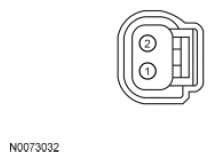 Courtesy of FORD MOTOR CO.
| Pin |
Circuit |
| 2 |
VPWR (Vehicle Power) |
| 1 |
EVAPCP (EVAP Canister Purge) |
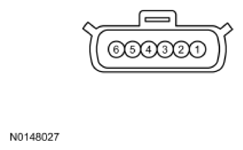 Courtesy of FORD MOTOR CO.
| Pin |
Circuit |
| 6 |
VPWR (Vehicle Power) |
| 5 |
FTIV (Fuel Tank Isolation Valve) |
 Courtesy of FORD MOTOR CO.
| Pin |
Circuit |
| 1 |
FTP (Fuel Tank Pressure) |
| 2 |
SIGRTN (Signal Return) |
| 3 |
VREF (Reference Voltage) |
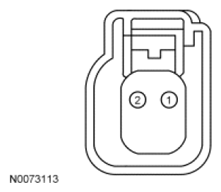 Courtesy of FORD MOTOR CO.
| Pin |
Circuit |
| 2 |
VPWR (Vehicle Power) |
| 1 |
VBV (Vapor Blocking Valve) |
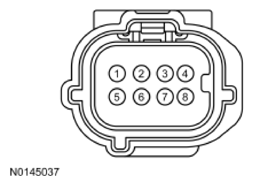 Courtesy of FORD MOTOR CO.
| Pin |
Circuit |
| 1 |
EVAPLDPSV (EVAP Leak Detection Pump Switching Valve) |
| 7 |
EVAPLDPPR (EVAP Leak Detection Pump Pressure) |
| 4 |
EVAPLDP (EVAP Leak Detection Pump) |
| 8 |
SIGRTN (Signal Return) |
| 6 |
VREF (Reference Voltage) |
| 3, 5 |
VPWR (Vehicle Power) |
 Courtesy of FORD MOTOR CO.
| Pin |
Circuit |
| E29 |
EVAPLDPSV (EVAP Leak Detection Pump Switching Valve) |
| B31 |
EVAPLDPPR (EVAP Leak Detection Pump Pressure) |
| B23 |
EVAPLDP (EVAP Leak Detection Pump) |
| E24 |
VBV (Vapor Blocking Valve) |
| E24 |
FTIV (Fuel Tank Isolation Valve) |
| B26 |
FTP (Fuel Tank Pressure) |
| E42 |
EVAPCP (EVAP Canister Purge) |