Pinpoint Test
- RECHECK THE Body Control Module (BCM) Diagnostic Trouble Codes (DTCs)
- Ignition ON.
- Using a scan tool, perform BODY CONTROL MODULE (BCM) self-test.
- Clear the Diagnostic Trouble Codes (DTCs). Repeat the Body Control Module (BCM) self-test.
- Is Diagnostic Trouble Code (DTC) U3003:16 still present?
- Yes:
GO to step 2
.
- No:
The system is operating normally at this time. The Diagnostic Trouble Code (DTC) may have been set due to a previous low battery voltage condition.
- CHECK FOR CHARGING SYSTEM Diagnostic Trouble Codes (DTCs) IN THE Powertrain Control Module (PCM)
- Using a scan tool, perform Powertrain Control Module (PCM) Key ON Engine OFF (KOEO) self-test.
- Retrieve the continuous memory Diagnostic Trouble Codes (DTCs) from the Powertrain Control Module (PCM).
- Is Diagnostic Trouble Code (DTC) P0562, P0620, P0622, P0625, P0626 or P065B set in the Powertrain Control Module (PCM)?
- CHECK THE BATTERY CONDITION AND STATE OF CHARGE
- Ignition OFF.
- Check the battery condition and verify the battery is fully charged. REFER to DIAGNOSTIC ROUTINE A
.
- Is the battery OK and fully charged?
- CHECK THE Body Control Module (BCM) VOLTAGE Parameter Identification (PID)
- Ignition ON.
- Measure and record the voltage at the battery.
- Using a scan tool, view Body Control Module (BCM) voltage Parameter Identification (PID) (V_BATT).
- Is the voltage within 0.2 volt of the recorded battery voltage?
- Yes:
GO to step 7
.
- No:
GO to step 5
.
- CHECK THE Body Control Module (BCM) VOLTAGE SUPPLY
- Ignition OFF.
- Disconnect: Body Control Module (BCM) C2280G.
- Ignition ON.
- Measure:
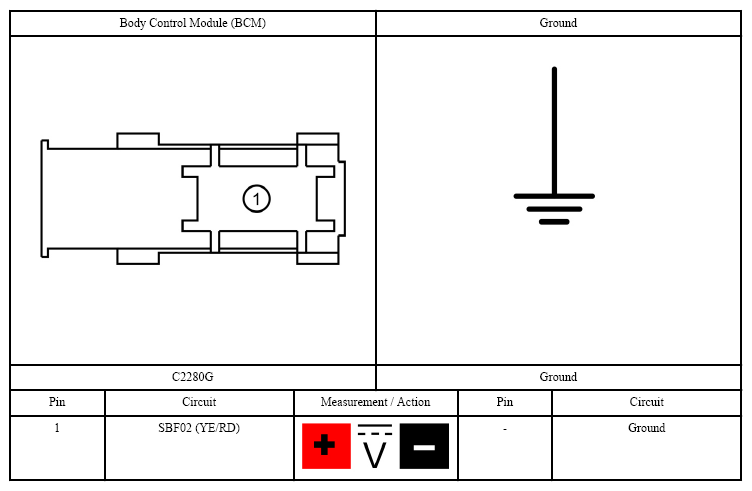 Courtesy of FORD MOTOR CO.
- Is the voltage within 0.2 volt of the recorded battery voltage?
- Yes:
GO to step 6
.
- No:
REPAIR the circuit for high resistance. CLEAR the Diagnostic Trouble Code (DTC).
- CHECK THE Body Control Module (BCM) GROUND CIRCUIT FOR HIGH RESISTANCE
- Ignition OFF.
- Disconnect: Body Control Module (BCM) C2280D.
- Measure:
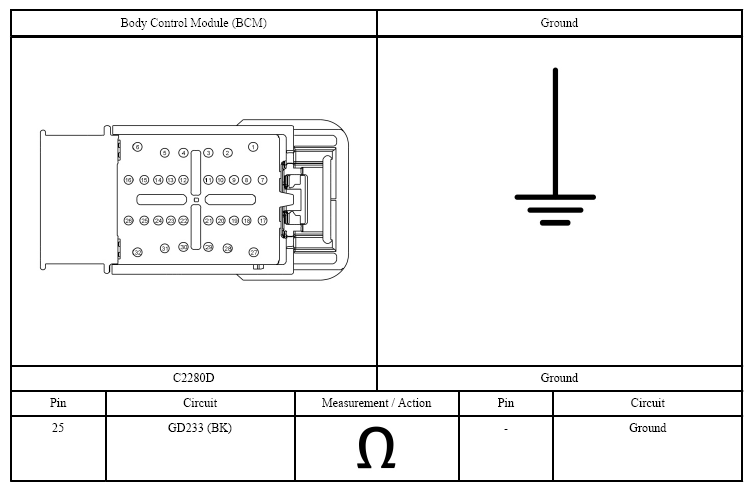 Courtesy of FORD MOTOR CO.
- Is the resistance less than 3 ohms?
- Yes:
GO to step 7
.
- No:
REPAIR the circuit for high resistance. CLEAR the Diagnostic Trouble Code (DTC).
- CHECK FOR CORRECT Body Control Module (BCM) OPERATION
- Disconnect the Body Control Module (BCM) connectors.
- Repair:
- corrosion (install new connector or terminals - clean module pins)
- damaged pins - install new terminals/pins
- pushed-out pins - install new pins as necessary
- Reconnect the Body Control Module (BCM) connectors and make sure they seat and latch correctly.
- Operate the system and determine if the concern is still present.
- Is the concern still present?
- Yes:
CHECK OASIS for any applicable Technical Service Bulletins (TSBs). If a Technical Service Bulletin (TSB) exists for this concern, discontinue this test and follow Technical Service Bulletin (TSB) instructions. If no Technical Service Bulletins (TSBs) address this concern, INSTALL a new Body Control Module (BCM). REFER to BODY CONTROL MODULE (BCM) - WITH INTELLIGENT ACCESS (IA) or REFER to BODY CONTROL MODULE (BCM) - WITHOUT INTELLIGENT ACCESS (IA) .
- No:
The system is operating correctly at this time. The concern may have been caused by module connections. ADDRESS the root cause of any connector or pin issues. CLEAR the Diagnostic Trouble Codes (DTCs).