Test A: Speed Control Is Inoperative
- Check For Voltage To Speed Control
Servo/Actuator
- Disconnect speed control servo/actuator
connector C136 (located near master cylinder). Turn ignition on. Using
a voltmeter, check voltage between speed control servo/actuator
connector C136 terminals No. 7 and 10. See
Fig 1
. If battery voltage
exists, go to step 4). If battery voltage does not exist, go to next
step.
- Check Ignition Circuit
- Turn ignition
switch to RUN position. Using a voltmeter, check voltage between
ground and speed control servo/actuator connector C136 terminal No. 7.
See Fig 1
. If
battery voltage exists, go to next step. If battery voltage does not
exist, check instrument panel fuse No. 6 (15-amp) and replace as
necessary. If fuse is okay, repair open power circuit. If fuse
repeatedly blows check circuit for short to ground and repair as
necessary. Retest system operation.
- Check Speed Control Servo/Actuator Ground
Circuit
- Using an ohmmeter, check resistance between ground
and speed control servo/actuator connector C136 terminal No. 10. See Fig 1
. If resistance
is less than 5 ohms, repeat step 1). If resistance is 5 ohms or more,
repair open in Pink/Orange wire between speed control servo/actuator
and ground. Retest system operation.
- Check Deactivator Switch Circuit
-
With brake pedal released, check voltage between speed control
servo/actuator connector C136 terminals No. 9 and 10. See
Fig 1
. If battery voltage
exists, go to step 7). If battery voltage does not exist, go to next
step.
- Check For Voltage To Deactivator
Switch
- Disconnect speed control deactivator switch connector
C261 (located on clutch pedal support). Using a voltmeter, check
voltage between ground and speed control deactivator switch connector
C261 Light Green/Red wire terminal. If battery voltage exists, go to
next step. If battery voltage does not exist, check instrument panel
fuse No. 9 (15-amp) and replace as necessary. Check for open Light
Green/Red wire. Repair as necessary. Retest system operation.
- Check Orange Wire
- Using an ohmmeter,
check resistance in Orange wire between speed control servo/actuator
connector C136 terminal No. 9 and deactivator switch connector C261.
See Fig 1
. If
resistance is less than one ohm, replace deactivator switch and retest
system operation. If resistance is one ohm or more, repair open in
Orange wire between deactivator switch and speed control
servo/actuator. Retest system operation.
- Check Brake Pedal Position (BPP) Switch (With
Brake Pedal Released)
- With brake pedal released, check
voltage between speed control servo/actuator connector C136 terminals
No. 4 and 10. See
Fig 1
. If battery voltage
exists, replace BPP switch or repair Red/Light Green or Light Green
wire between BPP switch and speed control servo/actuator. Retest
system operation. If battery voltage does not exist, go to next
step.
- Check Brake Pedal Position (BPP) Switch (With
Brake Pedal Applied)
- With brake pedal applied, check voltage
between speed control servo/actuator connector C136 terminals No. 4
and 10. If battery voltage exists, go to step 12). If battery voltage
does not exist, go to next step.
- Check Brake Pedal Position (BPP) Switch
Resistance
- Disconnect BPP switch connector C242 (located on
top of brake pedal support). Using an ohmmeter, check resistance
between BPP switch terminals while pressing brake pedal. If resistance
is less than 5 ohms, go to next step. If resistance is 5 ohms or more,
replace BPP switch and retest system operation.
- Check For Voltage To Brake Pedal Position
(BPP) Switch
- Using a voltmeter, check voltage between ground
and BPP switch connector C242 Light Green/Red wire terminal. If
battery voltage exists, go to next step. If battery voltage does not
exist, check instrument panel fuse No. 9 (15-amp) and replace as
necessary. Check for open Light Green/Red wire. Repair as necessary.
Retest system operation.
- Check Red/Light Green Wire & Light Green
Wire
- Using an ohmmeter, check resistance in Red/Light Green
wire and Light Green wire between speed control servo/actuator
connector C136 terminal No. 4 and BPP switch connector C242. If
resistance is less than 5 ohms, go to next step. If resistance is 5
ohms or more, repair open in Red/Light Green wire or Light Green wire
between BPP switch and speed control servo/actuator. Retest system
operation.
- Check Clutch Pedal Position (CPP) Switch
Resistance
- Disconnect CPP switch connector C260 (located on
top of clutch pedal support). Using an ohmmeter, check resistance
between CPP switch terminals while pressing clutch pedal. If
resistance is less than 5 ohms, go to next step. If resistance is 5
ohms or more, replace CPP switch and retest system operation.
- Check For Stuck Speed Control Switch
-
Without pressing any speed control switches, check voltage between
speed control servo/actuator connector C136 terminals No. 5 and 10.
See Fig 1
. If
battery voltage exists, replace speed control switch assembly. If
battery voltage does not exist, go to next step.
- Check ON Switch Operation
- While
pressing speed control ON switch, check voltage between speed control
servo/actuator connector C136 terminals No. 5 and 10. See
Fig 1
. If battery voltage
exists, go to step 18). If battery voltage does not exist, go to next
step.
- Check For Power To Air Bag Sliding
Contact
- Disable air bag system. See appropriate AIR BAG
RESTRAINT SYSTEM article. Disconnect air bag sliding contact connector
C233 (located at base of steering column). Using a voltmeter, check
voltage between ground and air bag sliding contact connector C233
(female side) Yellow/Light Green wire terminal. If battery voltage
exists, go to next step. If battery voltage does not exist, check
engine compartment fuse block HORN fuse No. 5 (20-amp) and replace as
necessary. Check for open Yellow/Light Blue wire. Repair as necessary.
Check horn relay and Yellow/Light Green wire. Repair as necessary.
Retest system operation.
- Check Air Bag Sliding Contact
-
Disable air bag system. See appropriate AIR BAG RESTRAINT SYSTEM
article. Remove drivers-side air bag module. Remove speed control
switch assembly. Using an ohmmeter, check resistance of all wires
between air bag sliding contact connector C233 and speed control
switch assembly connector. See WIRING DIAGRAMS. If resistance is not
.25-.50 ohm, replace air bag sliding contact and retest system
operation. If each resistance reading is .25-.50 ohm, go to next
step.
- Check Circuits Between Air Bag Sliding
Contact & Speed Control Servo/Actuator
- Disconnect speed
control servo/actuator connector C136 (located near master cylinder).
Using an ohmmeter, check resistance in Light Blue/Black wire and Dark
Green/Orange wire between speed control servo/actuator connector C136
and air bag sliding contact connector C233. See WIRING DIAGRAMS. If
resistance is 5 ohms or more, repair open in Light Blue/Black or Dark
Green/Orange wire(s). Retest system operation. If resistance is less
than 5 ohms, replace speed control switch assembly and retest system
operation.
- Check For Stuck Switch
- Without
pressing any speed control switches, check resistance between speed
control servo/actuator connector C136 terminals No. 5 and 6. See
Fig 1
. If resistance is
more than 3 k/ohms, go to next step. If resistance is 3 k/ohms or
less, replace speed control switch assembly and retest system
operation.
- Check SET/ACCEL Switch Operation
-
While pressing SET/ACCEL speed control switch, check resistance
between speed control servo/actuator connector C136 terminals No. 5
and 6. See Fig 1
. If
resistance is 646-714 ohms, go to next step. If resistance is not
646-714 ohms, replace speed control switch assembly and retest system
operation.
- Check Vehicle Speed Sensor (VSS)
Circuit
- Using an ohmmeter, check resistance between speed
control servo/actuator connector C136 terminals No. 3 and 10. See
Fig 1
. If resistance is
not 200-300 ohms, go to next step. If resistance is 200-300 ohms, go
to step 22).
- Check Vehicle Speed Sensor (VSS)
-
Disconect VSS connector C129 (located on left rear of transmission).
Using an ohmmeter, check resistance between VSS terminals. If
resistance is 200-300 ohms, check for open or short in Gray/Black or
Pink/Orange wire(s). Repair as necessary and retest system operation.
If resistance is not 200-300 ohms, replace VSS and retest system
operation.
- Check For Broken Or Binding Servo/Actuator
Cable
- Remove speed control servo/actuator cable from speed
control servo/actuator. Check for broken or binding cable by pulling
on cable ball slug to ensure throttle moves freely. Replace cable as
necessary and retest system operation. If cable is okay, replace speed
control servo/actuator and retest system operation.
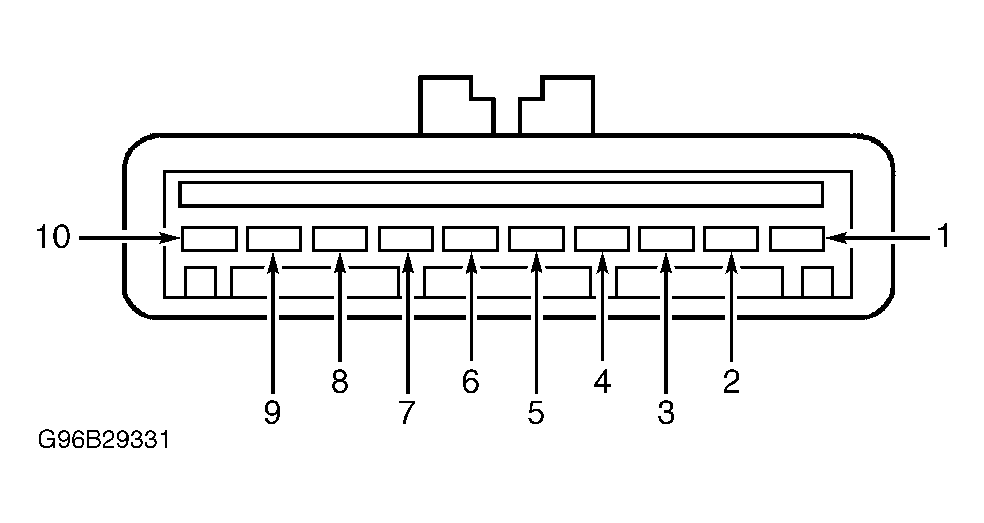 Courtesy of FORD MOTOR CO.