Tests Results
- If voltmeter reading indicates over voltage (more than two volts above battery voltage), stop engine and check ground connections between regulator and alternator and/or regulator and engine. Clean and tighten connections securely and repeat test.
- If over voltage still exists, disconnect regulator wiring plug and repeat tests. If over voltage condition disappears, replace voltage regulator and repeat tests.
- If over voltage still exists with regulator disconnected, a short is indicated in wiring harness between alternator and regulator. Repair short circuit, then replace voltage regulator and repeat tests with regulator plug connected.
- If voltmeter reading does not increase at least one volt, check for presence of battery voltage at alternator "BAT" terminal, and at regulator plug "A" terminal. If no voltage is present, an open wire is indicated.
 Courtesy of FORD MOTOR CO.
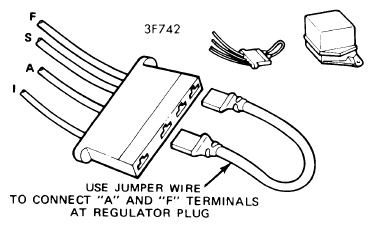
- Before performing other tests, the field circuit (regulator plug to alternator) must be checked for a grounding condition. If the field circuit is grounded and the jumper wire is used as a check at regulator wiring plug from "A" to "F" terminals, excessive current will cause heat damage to regulator wiring plug terminals and may burn the jumper wire. Also if the field circuit was grounded, the connector wire inside the regulator will be burned open and an under voltage condition will result.
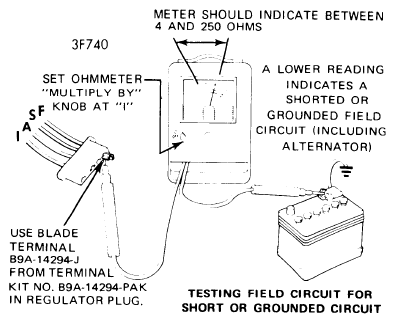
- Field circuit should be checked with the regulator wiring plug disconnected and an ohmmeter connected from "F" terminal of regulator plug to battery ground. Ohmmeter should indicate 4-250 Ohms. A lower reading indicates a short or ground circuit in field (including alternator).
 Courtesy of FORD MOTOR CO.
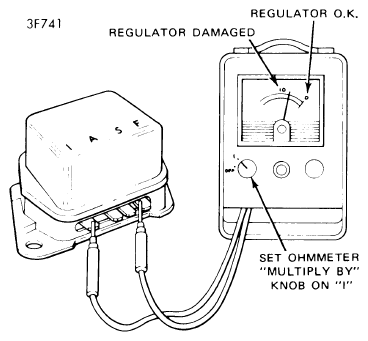
- Check regulator for a burned open wire by connecting an ohmmeter between "I" and "F" terminals on regulator. Zero Ohms is normal between terminals; if ohmmeter reads about 10 Ohms, the connector wire inside regulator is burned open. Repair field circuit ground before installing a new regulator.
 Courtesy of FORD MOTOR CO.