Road Test
- Prior to road testing, check fluid level, condition, and control cable adjustments. Add fluid and adjust control cable as needed.
- During testing, the transaxle should upshift and downshift automatically at approximate speeds as indicated in the appropriate AUTOMATIC SHIFT SPEEDS & GOVERNOR PRESSURES
charts. All shift speeds may vary somewhat due to production tolerances, rear axle ratio, or tire size. The important factor is the quality of the shifts. All shifts should be smooth, responsive, and with no slipping or engine speed flare-up.
- Slipping or flare-up in any gear usually indicates clutch, band, or overrunning clutch problems. The slipping clutch or band in a particular gear can usually be identified by noting transaxle operation in other selector positions and comparing which internal units are applied in those positions.
- For example, if transaxle slips in "D" (3rd gear), either the front or rear clutch is slipping. By selecting another gear which uses one of those units, not both, the clutch which is slipping can be identified. Refer to CLUTCH & BAND APPLICATION TABLE
in this article to determine which components are in use. Using this example, if transaxle also slips in Reverse, the front clutch is slipping. If it does not slip in Reverse, the rear clutch is slipping.
- Although this process of elimination can be used to detect any unit which slips and to confirm proper operation of good units, the actual cause of malfunction cannot easily be determined. Practically any condition can be caused by leaking hydraulic circuits or sticking valves. Therefore, unless an obvious condition exists, a transaxle should never be disassembled until hydraulic pressure tests have been made.
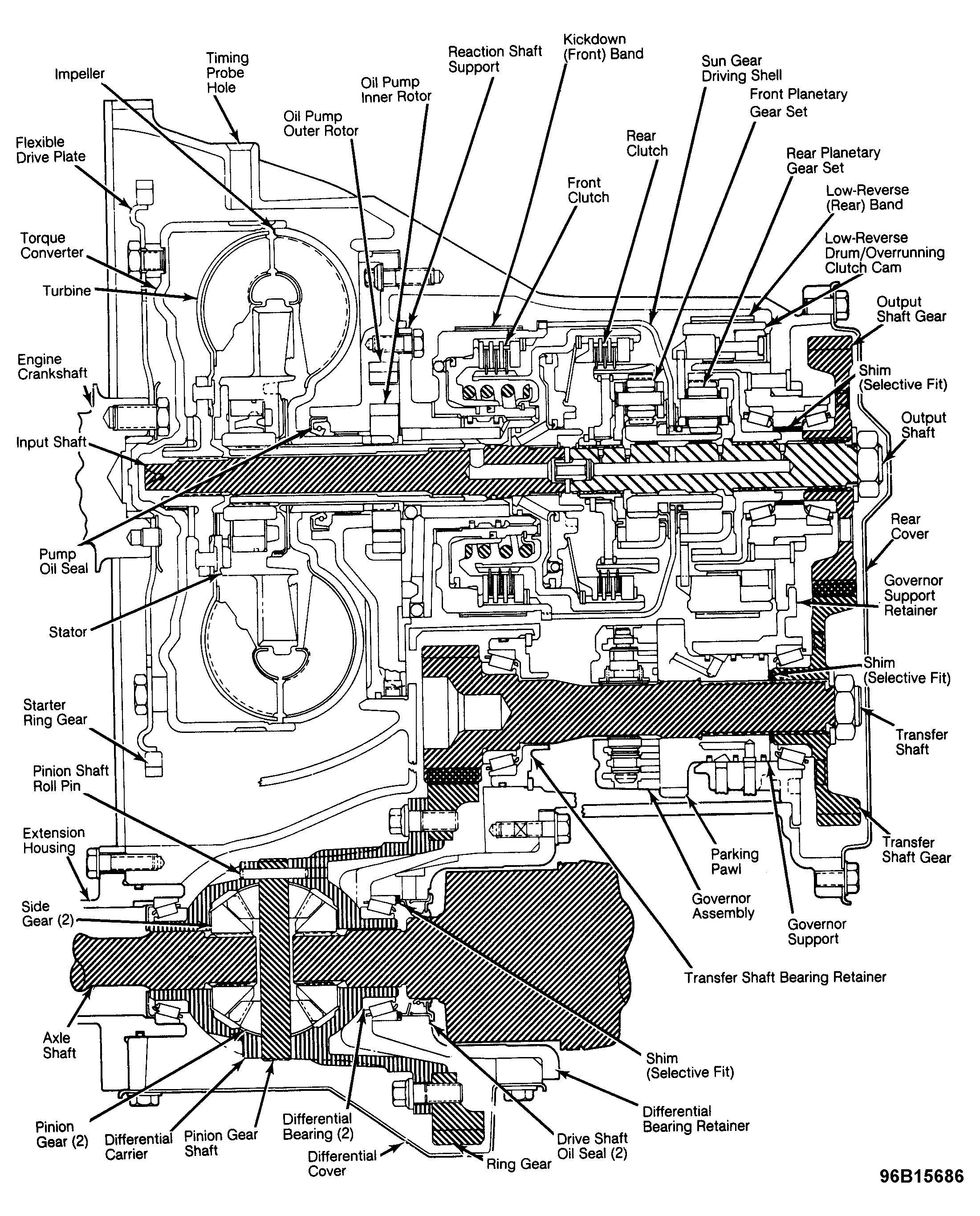 Courtesy of CHRYSLER MOTORS.
 CLUTCH & BAND APPLICATION
| Lever Position |
Front Clutch |
Rear Clutch |
Overrun Clutch |
Front Band |
Low-R Band |
| Drive (1st) |
..... |
X |
X |
..... |
..... |
| Drive (2nd) |
..... |
X |
..... |
X |
..... |
| Drive (Direct) |
X |
X |
..... |
..... |
..... |
| Second (1st) |
..... |
X |
X |
..... |
..... |
| Second (2nd) |
..... |
X |
..... |
X |
..... |
| 1-Low (First) |
..... |
X |
..... |
..... |
X |
| Reverse |
X |
..... |
..... |
..... |
X |