DTC P0400: EGR System Malfunction
- Perform basic diagnostic procedure. See BASIC DIAGNOSTIC PROCEDURE
. If DTC P0106 exists, diagnose and repair that DTC first. If DTC P0400 is only DTC set, go to next step.
- Start engine. Using scan tool, observe intake manifold absolute pressure. If pressure is more than 15.75 in. Hg, check installation of EGR valve, intake manifold pressure sensor and throttle body. If pressure is not more than 15.75 in. Hg, go to next step.
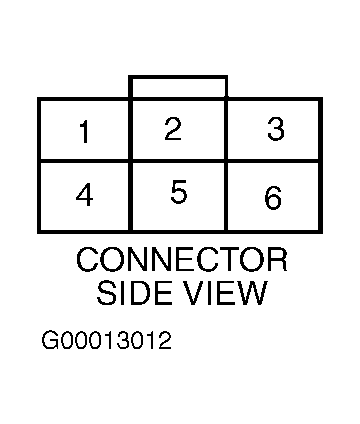
- Turn ignition off. Disconnect EGR solenoid valve connector. Turn ignition on. Using a DVOM connected to ground, measure voltage at EGR solenoid valve connector terminals No. 2 and No. 5. See Fig 1
. If voltage is more than 10 volts at both test points, go to next step. If voltage is not more than 10 volts at both test points, locate and repair open circuit in wiring between main relay and EGR solenoid valve.
- Turn ignition off. Remove EGR solenoid valve and ensure there is no foreign objects lodged between EGR valve and EGR valve seat. Clean and repair as required. Using an ohmmeter, measure EGR valve resistance between terminals No. 1 and No. 2, No. 3 and No. 2, No. 4 and No. 5 and No. 6 and No. 5. If resistance is 20-30 ohms at all test points, go to next step. If resistance is not 20-30 ohms at all test points, replace EGR solenoid valve.
- Turn ignition off. Ensure ECM connectors and EGR solenoid valve connector are properly installed. Turn ignition on. Using a DVOM connected to ground, backprobe ECM connector B137 (31-pin connector) terminals No. 13, 14, 25 and 26. See Figure
. If voltage is 10-13 volts at all test points, go to next step. If voltage is not 10-13 volts at all test points, locate and repair open circuit in wiring and check for poor terminal contact in ECM connector.
- Turn ignition off. Disconnect ECM connector B137 (31-pin connector) and EGR solenoid valve connector. Using an ohmmeter, measure resistance between ECM connector B137 (31-pin connector) terminal No. 13 and EGR harness connector terminal No. 4; between ECM connector B137 (31-pin connector) terminal No. 14 and EGR harness connector terminal No. 3; between ECM connector B137 (31-pin connector) terminal No. 25 and EGR harness connector terminal No. 6; and between ECM connector B137 (31-pin connector) terminal No. 26 and EGR harness connector terminal No. 1. If resistance is less than one ohm at all test points, go to next step. If resistance is not less than one ohm at all test points, locate and repair open circuit in wiring between ECM connector No. B137 (31-pin connector) and EGR solenoid valve.
- Using an ohmmeter connected to ground, measure resistance at ECM connector B137 (31-pin connector) terminals No. 13, 14, 25 and 26. If resistance at all test points is more than 1 megohm, go to next step. If resistance is not more than 1 megohm, locate and repair short circuit in wiring between ECM and EGR solenoid valve.
- Check ECM connector B137 (31-pin connector) and EGR solenoid valve connector for poor terminal contact. Repair connector terminal contact as required. If terminal contact is okay for both connectors, circuit has returned to normal. Clear memory and perform verification procedure. See CLEARING DIAGNOSTIC TROUBLE CODES
and VERIFICATION PROCEDURE
.
 Courtesy of SUBARU OF AMERICA, INC.